
A clearer way to choose
Why Choosing the Right Product Is Harder Than It Should Be
How to shop with confidence, avoid costly mistakes, and find products that fit your needs.
By Gold Tarpon Editorial · Reviewed October 15, 2026
Start with what you need
You can recognize a product you like and still have no clear way to tell whether it will work for you. Two appliances may look almost identical, yet one difference in their specifications can change how you use them every day.
The hard part is translating features into your life
A model number identifies a particular product. A feature name describes something it does. Neither tells you, by itself, whether that product solves your problem. The useful question is: what would this difference change about the way I cook, clean, work or spend?
Consider an air fryer. A larger capacity sounds useful, but total capacity does not tell you whether two foods can cook at different temperatures at the same time. For a range hood, an attractive finish does not settle the questions of width, ducting or installation. For portable power, watts and watt-hours describe different things: power and stored energy. Neither figure alone establishes how long your particular setup will run.
Write down the job before you compare the products. “I want to cook two foods on separate schedules” is more useful than “I want the premium model.” Treat a feature as essential when its absence prevents that job. Treat it as optional when it adds convenience you could reasonably do without.
A small comparison rule
Compare the same attribute, for the exact model, using the same units. If one retailer lists total capacity and another lists basket capacity, pause before treating those numbers as equivalent. A missing detail is a question to resolve, not permission to assume.
Retailer descriptions can emphasize different features or omit information you need. Baymard's product-list usability research describes how inconsistent or missing attributes make comparison harder. A tidy row of product cards can still leave you doing the work of finding the comparable facts. Read Baymard's research.
Reviews add another layer. A coffee maker praised for its convenience may disappoint someone who wants control over every brewing step. Look for the reviewer's use case, the exact model and recurring details. An opinion is most useful when you can see how it relates to your own needs.
More choice is not automatically worse. A 2010 meta-analysis of 50 published and unpublished experiments found an average choice-overload effect close to zero, with considerable variation across studies. The practical lesson is modest: there is no universal number of options that makes shopping easy. A meaningful way to compare them matters. Scheibehenne, Greifeneder and Todd's review.
A mismatch has a cost
The price of a mistake extends beyond the receipt
Estimated value of merchandise returned in the United States in 2025, according to the National Retail Federation and Happy Returns.
Retailers estimated returns would equal 15.8% of annual sales. These are overall return estimates, not a measure of wrong-product choices or money lost by consumers. NRF, October 15, 2025.
A return can happen for many reasons. Those figures do not tell us how often someone selected an unsuitable model, and they do not establish how many returns a shopping tool could prevent.
Even when a refund is available, a mismatch can mean repacking a heavy appliance, arranging transport, waiting for a replacement or rescheduling installation. Shipping or restocking charges may also apply under the seller's terms. Those costs vary; check them before buying rather than assuming a return will be free.
Some checks are very specific. A robot vacuum's cleaning features do not establish that it will clear your furniture or handle your floor layout. Coffee selection includes the form your equipment accepts, such as whole bean or ground. A stone-fruit order raises a different question: does its expected delivery timing suit when you plan to serve it? The right comparison begins with the constraint that could make the purchase unusable.
You can ask for help without making an immediate decision
Shopping in person can put unfamiliar terminology, a budget decision and a conversation with a salesperson into the same few minutes. You may worry about asking a basic question or agreeing to an upgrade before you understand it. Giving yourself a repeatable process can make that conversation more useful.
Knowledgeable sales professionals can explain differences, identify missing accessories and help you check details. Research also distinguishes kinds of pressure. A 2016 study of consumer perceptions linked aggressive sales pressure with lower trust and satisfaction, while directive guidance did not show the same negative relationship. It used a quota sample and a statistical model, not a national estimate of shopper anxiety or proof that every sales interaction has those effects. Zboja, Clark and Haytko's study.
Bring three questions, and permission to pause
- “Which exact model meets this requirement, and where is that documented?”
- “What would I give up by choosing the less expensive option?”
- “What is the complete cost, including anything needed to use or install it?”
Set a budget before the conversation. Keep the model number and written terms. If a detail remains unclear, take time to check it. “I want to compare the specifications before deciding” is a complete next step.
These are practical preparation suggestions, not a promise to eliminate anxiety or guarantee a better purchase. The FTC likewise recommends comparing exact products and total costs and checking seller and return information. FTC online shopping guidance.
From a catalog to a decision
Start with your requirements. Then look at products.
Gold Tarpon's Help Me Choose starts with what the shopper needs. It asks relevant questions, uses the answers to narrow available choices, and helps shoppers compare meaningful differences. Gold Tarpon uses a proprietary product-selection methodology based on consumer requirements and documented product information.
Not every product will meet every requirement. When the available information does not support a suitable match, Gold Tarpon makes those limitations clear rather than recommending a product that doesn't adequately meet the shopper's needs.
See the process
One dinner, two cooking needs
Educational illustration · Not a personalized Help Me Choose recommendation
Imagine preparing a main dish and a side that often need different temperatures. You also have limited counter space. This example uses a real Gold Tarpon question and manufacturer-documented layouts to show what to investigate. It does not run the matching system or identify a suitable product for you.
- 1
Identify the job
Separate temperature control matters more to this shopper than a long list of cooking presets.
Do two foods need different temperatures at the same time?
Example answer: Often
This is an existing Air Fryer Help Me Choose question. The shopper must also work through portion size, foods that need to fit, available space and cleanup needs.
- 2
Distinguish the formats
A single basket, two independently controlled baskets and one oven cavity organize cooking differently. For this requirement, investigate independent cooking zones before comparing total capacity or presets.
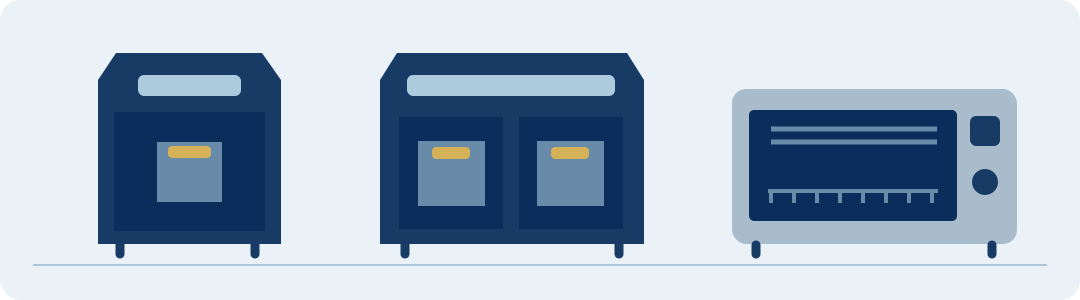
Original schematic illustrations, not photographs, scale drawings or exact model renderings. A format distinction can focus your research. It does not establish that a particular appliance fits your counter, food or full set of requirements.
- 3
Compare the differences that matter
These three documented examples illustrate the format question. They are not ranked, shortlisted or presented as recommendations.
Ninja AF141
One 5-quart basket
A single cooking zone. Extra cooking functions do not create two independent temperature zones.
Manufacturer specificationsNinja DZ901
Two independent 5-quart baskets
Two cooking zones, 10 quarts in total. Independent temperatures address the example's format question; overall suitability is still unconfirmed.
Manufacturer specificationsNinja SP151
One countertop oven cavity
An oven format with air frying and other functions. Multiple functions do not mean separate temperature zones.
Manufacturer specificationsThe next checks: Measure the intended space, read each model's operating-clearance instructions, check the food and portions against usable cooking space, and review cleaning requirements. Do not infer usable space or installation fit from total capacity.
- 4
Evaluate the offer
After establishing suitability, compare the exact model, item condition, delivered cost, seller terms and warranty coverage. A lower headline price can be a different package or condition.
Gold Tarpon was developed to help shoppers connect their product research with participating retailers, making it easier to compare available purchasing options and costs before deciding where to buy.
Work through the Air Fryer questions Read the Air Fryer buying guide
Keep this beside your comparison
Before you buy
Use these checkboxes as a temporary checklist. Your checks stay on this page only and are not saved or sent.
For the purchasing checks, see the FTC's online shopping and warranty guidance. Seller policies and manufacturer instructions control the details of a particular purchase.
A clearer starting point for your next purchase
Buying the right product shouldn't require hours of confusing searches or a detailed understanding of every manufacturer's terminology.
Gold Tarpon has made the process simpler by helping consumers identify their needs, narrow their choices, compare suitable products, and find retailers offering the products they're interested in purchasing.
Choose a category and explore Help Me Choose
Continue with guides for range hoods, coffee and espresso makers, air fryers, robot vacuums, portable power stations, coffee and stone fruit.
Research and sources
This is original Gold Tarpon editorial analysis, supported by the sources below. Research findings are described within their scope; examples are illustrations, not measured savings or live recommendations. Manufacturer references support the example's specifications, not an endorsement.
- NRF and Happy Returns: 2025 retail returns estimates, October 15, 2025. Research included 358 ecommerce professionals at large U.S. merchants and 2,006 consumers who had made an online return in the prior year. The retailer estimates concern overall returns; the consumer survey is not representative of all shoppers.
- Scheibehenne, Greifeneder and Todd (2010), Can There Ever Be Too Many Options? A Meta-Analytic Review of Choice Overload. Journal of Consumer Research, 37(3), 409–425. Review of 63 conditions from 50 experiments, 5,036 participants; average effects and variation do not support a universal overload claim.
- Zboja, Clark and Haytko (2016), An offer you can't refuse: consumer perceptions of sales pressure. Journal of the Academy of Marketing Science, 44(6), 806–821. Quota-sample consumer research distinguishing aggressive pressure from directive guidance; not a prevalence estimate.
- Baymard Institute: product-list information design research. Qualitative usability findings on comparable attributes; no conversion or performance claim is made for Gold Tarpon.
- FTC: Online Shopping, May 2023. Practical guidance on exact products, costs, sellers, records and returns.
- FTC: Warranties, July 2023. Guidance on reading coverage and handling warranty claims.
Air Fryer example: manufacturer specifications for AF141, DZ901 and SP151. Question wording comes from Gold Tarpon's existing Air Fryer questionnaire. Specifications and source links reviewed October 15, 2026.
Visuals: original SVG illustrations and HTML/CSS graphics created for this guide. No retailer photography, customer photographs or testimonials are used.